

What Vacumn Clean Up Mold On Walls
 Guide to Mold Cleaning Products & Approaches
to Remove Toxic Mold in Buildings
- POST a QUESTION or Comment about the best choices of chemicals or cleaners to make clean up or remove mold contamination
InspectAPedia tolerates no conflicts of interest. Nosotros take no human relationship with advertisers, products, or services discussed at this website.
This document describes choices among common cleaning substances and methods used for mold cleanup of edifice surfaces and contents.
This article series provides an easy to understand step-by-pace guide for dealing with toxic or allergenic indoor mold and other indoor contaminants: what to do about mold.
The steps in this certificate will exist sufficient for many building owners who want to practice their own mold investigation, mold testing, mold cleanup, and mold prevention in their home or office.
Nosotros besides provide an Commodity Index for this topic, or you tin can try the page superlative or bottom SEARCH BOX as a quick way to find information you need.
What to Use to Clean Off Mold from Building Surfaces, Contents, Items
 Just beneath we reply some of the most common mold cleanup questions posed by our readers, followed past a detailed homeowner'south guide to popular mold cleaners, mold removers, mold killers, and other mold cleanup approaches.
What to apply to make clean off mold from all of the exposed difficult, cleanable surfaces: to clean off a moldy surface, yous could use unproblematic clean h2o, soapy water, spray cleaners, or if you adopt, a commercial biocide (follow their directions) or a dilute bleach cleaning solution.
Simply because so many readers take asked near specific mold "cleaning" or mold "killing" methods we list and comment on these approaches below.
- Water to clean mold:
Later on discussing mold cleaning with an practiced mycologist (J.H. NYS DOH), we agreed that simple h2o and a scrubby sponge work fine for cleaning off superficial mold.
- Soap and water to clean mold:
using whatsoever household cleaner or soap solution, works well where nosotros want to leave a nicer looking surface.
- Color of mold does not touch choice of mold cleaner:
it does non matter what color or kind of mold you are cleaning up - in nearly cases the cleaning methods will be just the same.
- Type of surface beingness cleaned impacts mold cleaner choice:
the blazon of moldy surface or material being cleaned up matters a lot. Difficult surfaces such every bit wooden objects or wood framing are easy to clean with any cleaning product and a scrubby sponge, rags, paper towels.
Encounter MOLD CLEANUP - WOOD FRAMING & PLYWOOD.
- Hard surfaces that don't blot water are easiest to clean: wipe the detail in or with a solution of warm water and detergent.
- Washable items such every bit clothes, curtains: employ your washing machine and laundry detergent. Clothing that cannot be laundered tin exist dry-cleaned.
- Dusty surfaces that are not actually belongings mold growth tin can exist vacuumed or cleaned using normal methods.
Irregular surfaces such as a roof deck penetrated by nails cannot exist efficiently cleaned by paw-scrubbing, and media diggings may be needed. It is nigh incommunicable to finer clean moldy carpeting or moldy upholstered couches.
Moldy insulation cannot be cleaned and must exist replaced.
See INSULATION MOLD Contamination TEST
See also MOLD CLEANUP by MEDIA Blasting
- Carpeting (wall to wall), carpet padding, thick upholstered furniture, sofas, and similar items that have been exposed to wet moldy conditions cannot be effectively cleaned and are unremarkably disposed-of. (Valuable antique furniture might be stripped and sent to be reupholstered.)
Don't spend more on cleaning an object than its replacement price or value.
- Full surface area of moldy materials affects mold cleanup approach:
big areas of mold, more than than xxx sq.ft. need to exist cleaned upward by a professional; if you are tackling a small area of mold, or are hiring someone to do so, exist sure that the cleanup stops, and a professional person is consulted, if your demolition/cleaning process discovers a large expanse of mold that you had not seen before.
Come across MOLD CLEANUP GUIDE- HOW TO GET RID OF MOLD.
- Crusade of mold affects mold cleanup arroyo:
while it may be reasonable to begin a mold cleanup project equally presently equally the mold problem is discovered (we practice want to get rid of mold indoors), the cleanup job will exist ineffective
and perhaps you'll be wasting the endeavour and expense if y'all don't identify and fix the cause of indoor mold contamination in the first place. One time you have identified and corrected the crusade of mold in your building, you'll also want to take steps to foreclose future mold growth.
See MOLD PREVENTION GUIDE.
- At Black or Light-green ALGAE STAIN REMOVE / PREVENT we include formulas for bleach solution used to clean algae & mold stains off of roof surfaces
- At MOLD CLEANERS - WHAT TO USE [this article] we describe the basics of how to clean off moldy building surfaces and what simple products to use.
- At MOLD SPRAYS, SEALANTS, PAINTS nosotros provide a guide to buying and using fungicidal sprays and sealants, nosotros describe mistakes in use of mold sprays, and nosotros define biocide, disinfectant, sanitizer and related terms.
- At DISINFECTANTS & SANITIZERS, SOURCES we list suppliers of biocides, fungicidal sealants, and related mold sprays and cleanup products.
- At FUNGICIDAL SPRAY & SEALANT Employ GUIDE we provide a Guide to Use of Fungicidal Sealants on Wood Edifice Material
- At SEWAGE CLEANUP PROCEDURES & STANDARDS nosotros discuss how to use bleach, disinfectants & sanitizers in buildings
- At SIDING, Wood CLEANERS, STAINS, PAINTS - a split up article on how to remove stains on siding & how to choose the proper paint or stain blanket - we include formulas for bleach solution used to clean woods siding or trim stains
Guide to Popular Approaches to Cleaning up Mold in a building or on edifice contents.
 Basic mold cleanup safety warning: If you are doing your ain mold cleanup be certain to wear appropriate protective habiliment, goggles, HEPA-rated respirator, better, a respirator that filters both fine particles (HEPA) AND that filters out the MVOCs (gases produced by mold), gloves, etc.
Watch out: If you are asthmatic, immune impaired, sick, elderly, or an infant, information technology would exist smart to have an skilful make clean up your mold while you stay out of the moldy area or edifice.
The U.S. EPA recommends these mold cleanup safety tips [our comments are in brackets]
- Avoid breathing in mold or mold spores. In order to limit your exposure to airborne mold, you lot may want to wear an N-95 respirator, bachelor at many hardware stores and from companies that annunciate on the Internet. (They cost almost $12 to $25.)
Some N-95 respirators resemble a paper dust mask with a nozzle on the front, others are made primarily of plastic or rubber and have removable cartridges that trap nigh of the mold spores from entering.
In order to be effective, the respirator or mask must fit properly, so carefully follow the instructions supplied with the respirator.
Please note that the Occupational Safety and Health Administration (OSHA) requires that respirators fit properly (fit testing) when used in an occupational setting; consult OSHA for more information (800-321-OSHA or world wide web.osha.gov).
- Article of clothing gloves. Long gloves that extend to the middle of the forearm are recommended.
When working with h2o and a balmy detergent, ordinary household prophylactic gloves may exist used. If you lot are using a disinfectant, a biocide such equally chlorine bleach, or a stiff cleaning solution, you lot should select gloves fabricated from natural safe, neoprene, nitrile, polyurethane, or PVC (see Cleanup and Biocides).
Avoid touching mold or moldy items with your bare hands.
Bleach makes people more comfortable virtually their mold cleanup chore but except for cosmetic reasons such every bit removing stains, it is unnecessary in a mold cleanup project -See MOLD KILLING GUIDE and
see MOLD CLEANUP with BLEACH
- Article of clothing goggles. Goggles that do not have ventilation holes are recommended. Avoid getting mold or mold spores in your optics.
We have had a few reported cases of actual loss of an centre past people who got moldy debris into an eye and failed to recognize and diagnose the problem until too tardily. Only wearing goggles without vent holes, while safer, may hateful that your goggles fog and you lot tin can't encounter.
Don't let this mean you lot but give up and take them off. Apply anti-fogging goggle or eyeglass products.
Run across MOLD CLEANUP GUIDE- HOW TO GET RID OF MOLD for details.
- Air purifiers for mold: portable indoor air purifiers are ineffective at correcting a mold problem in a building - but consider the mold reservoir in a mold contaminated home as an infinite particle source.
The air "purifier" may pull some particles out of the air but it is no more than effective at removing a mold problem than standing in the kitchen, waving your vacuum cleaner wand in the air, and expecting to pick up all of the grit from the nearby living room floor.
An air purifier will indeed reduce the number of airborne particles if information technology is operated in a pocket-sized-enough closed room, and that may ameliorate occupant comfort, but air purifiers do not cure nor clean upwardly nor remove an indoor toxic or allergenic mold problem.
- Air scrubbers or air sprays of fungicides and disinfectants: are popular amid mold remediation companies who expect the mold clearance inspector to rely on an air exam to "laissez passer" the edifice subsequently a mold cleanup job.
Run across MOLD CLEARANCE: FOLLOWUP STEPS for a give-and-take of mold clearance inspections.
Their proponents fence that these products "knock down" airborne mold in the building - a reasonable view considering that demolition and cleaning of moldy building surfaces can stir upwardly loftier levels of airborne mold.
A similar "cleaning" of the air inside a edifice after mold remediation may be attempted past "fogging" with a fungicidal sealant paint (likewise effective, and also risky
Run into FUNGICIDAL SPRAY & SEALANT USE GUIDE and our comments on fungicidal sprays but below).
The mold remediator who has constructed a contained, sealed area does not want to exist blamed for airborne mold entering the edifice from other areas that were non treated. This makes sense if the building was non fully and competently inspected in the start place, equally other problem mold reservoirs outside the remediation area may be nowadays.
Just in most locations, merely ventilating the building with fresh air afterwards cleanup can produce the same results.
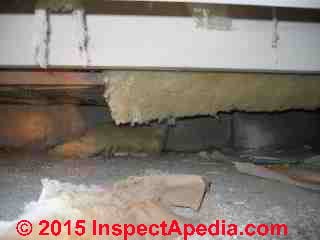
Beware: if the moldy materials were not fairly removed, if moldy surfaces or debris were left in the work surface area, no amount of air sprays, surface sprays, or air scrubbing using a HEPA-filtered air handler, will correct the indoor mold trouble any more than than you can pick up dust from a living room floor by continuing in the kitchen and waving your vacuum cleaner wand in the air.
Our photo (to a higher place) shows a horrible "professional mold remediation job" in which the cleaning company left moldy insulation and droppings in the clamber space.
The contractor simply stood at the crawl space entry and sprayed in some fungicidal paint.
- Bleach to clean mold: Be sure to read
- MOLD CLEANUP with BLEACH
- MOLD CLEANUP - Wood FRAMING & PLYWOOD
- MOLD CLEANUP - MISTAKES to AVOID.
- TRAPPED MOLD Betwixt Wood SURFACES a give-and-take of the question of demand to remove mold from mated, inaccessible edifice surfaces such equally between the top of a floor joist and the under-side of subflooring.
Once yous've read about bleach it will be clear that whatsoever cleaning method that removes surface mold is fine: h2o, soap and h2o, household cleaners.
Stains that are left behind, such as on framing lumber, are generally harmless (fungal hyphae left in the actual wood), provided that you keep the building properly dry.
And if you don't keep the edifice properly dry, new mold growth volition readily occur on many surfaces regardless of the old stains that were left from the prior mold cleanup.
- Carpet cleaning to remove mold from wet moldy carpeting is not effective regardless of method used (dry chemical, steam, moisture scrubbing). Dusting carpets with baking soda is also ineffective at removing problem mold, though information technology might brand the carpeting smell amend for a while.
Steam cleaning moldy carpets will neither impale nor remove enough mold in the carpeting nor in carpet padding to make such materials salvageable if the carpeting was moisture and/or harboring actual mold growth.
Vacuuming a carpet exposed to moldy dust (say from other building areas) is fine if you use a HEPA-rated vacuumcleaner - otherwise you may simply be aerating (sending airborne) moldy dust and other irritating particles.
Vacuuming volition not effectively clean a carpet that has been wet or has harbored mold growth.
Wet moldy carpeting is mostly discarded as is wet moldy carpet padding or carpeting padding that was below wet moldy carpets.
- Caulk over mold? Don't caulk over moldy caulk such equally in a bathroom or around a window. Even "mildew resistant" caulks are non proof confronting ultimate mold re growth in the new caulk, and yous have non removed the problem.
Cut and strip away moldy caulk, make clean the exposed surfaces, be sure at that place is no leak behind the area to be caulked, then re-caulk with a mold resistant caulk (oft sold under the incorrect name equally "mildew resistant caulk".
- Clothes washing and dry cleaning to remove mold from article of clothing, bedding, even curtains, is generally very effective for these soft goods.
Upholstered furniture, pillows, mattresses that take been moisture and moldy are by and large discarded as surface cleaning by any method (fifty-fifty steam) is unable to remove mold from deeper in the material.
- Deck Cleaner Solution vs. Media Blasting to clean mold: For cosmetic reasons nosotros might apply a more than aggressive cleaner or fifty-fifty bleach, but that'south for appearance, not considering we're trying to "kill" mold. For case, where cleaning an indoor surface where woods is left exposed for cosmetic or aesthetic reasons, we may
use MOLD CLEANUP by MEDIA BLASTING or nosotros may use a deck cleaner solution (intended for outdoor utilise). The downwards side of any indoor cleaning that uses a water-based spray in quantity is having to deal with the water itself - dumping more than water into a moldy building invites more than mold problems.
So wet methods for mold cleaning work better outdoors or over a concrete floor that can exist quickly cleaned and dried.
- Detergents to clean moldy surfaces: household cleaning detergents are just fine, liquid or powder are every bit effective and involve less suds to be cleaned off.
- Dehumidifiers for mold: a dehumidifier volition not clean up nor right an existing mold problem, and temporarily, when you driblet the humidity in a clammy moldy area, the level of airborne mold will actually increase (the drying mold decides to release its airborne spores to find a better abode).
A dehumidifier is an important office of mold prevention, notwithstanding. See these articles on indoor moisture level command:
- MOLD PREVENTION GUIDE
- HUMIDITY Control TO Forestall MOLD
- DEW Signal Tabular array - CONDENSATION Indicate GUIDEfor an caption of dew points and indoor humidity in buildings,
- Wet PROBLEMS: Cause & CURE
- HOUSEWRAP AIR & VAPOR BARRIERS
- VENTILATION in BUILDINGS.
- Dishwasher to remove mold: a dishwasher is effective for removing mold from most dishware and glassware; on occasion we find mold stains that have developed below cracked glazing on antique dishware, and we've had some success in correcting this corrective trouble using bleach (below).
- Enzymes or fungicides to make clean mold: while these products can produce prissy looking results, and while their claim of "killing" all mold (an exaggeration in many cases), are not relevant to a proper mold cleanup (where removal is the cardinal discussion), their use is not generally necessary.
Read CLEANUP with BLEACH for a more consummate explanation of the divergence between "killing" mold and "removing" mold.
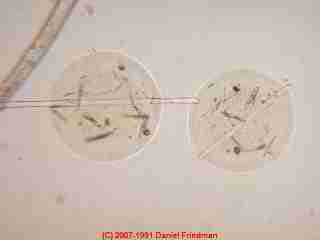
- Fungicidal sprays to "make clean" mold: can be an constructive surface cleaning method, but much too ofttimes we notice that the mold "expert" rushes the job, relying on the spray to "kill" or "immobilize" mold without beginning finding and removing the mold actual problem mold reservoir.
Sprays are not an effective substitute for actually cleaning or removing problem mold. See these manufactures:
- FUNGICIDAL SPRAY & SEALANT Use GUIDE
- FUNGICIDAL SPRAY ADVANTAGES
- MOLD SPRAY WARNINGS
- MOLD SPRAYS, SEALANTS, PAINTS - sources, choices, suppliers
Our photo (left) shows small particles that were immobilized in airborne aerosol of a articulate fungicidal sealant spray.
- HEPA Vacuum Cleaning to remove mold: a HEPA-rated vacuum cleaner is used during dry surface cleaning methods to reduce airborne moldy dust and besides to clean upwardly moldy dust and debris from building surfaces.
Sentinel out: Don't use an ordinary household vacuum cleaner or "shop vac" that is not HEPA rated or you will simply increment the level of airborne mold in the building.
For an effective reduction of indoor dust levels and moldy dust levels in building areas exterior of the mold remediation area, where no mold growth contamination was nowadays, HEPA vacuuming is often recommended as a final step in complete building cleaning.
- Laundry soap to clean or remove mold: laundry lather is effective as a household cleaner but may exist more concentrated than you lot need; we apply laundry lather and two washings to make clean up moldy washable goods like towels, clothing. Sometimes mold leaves a stain on soft goods and bleaching may be needed for cosmetic reasons.
- Media blasting to remove mold as we mention above, is useful for cleaning wood surfaces to be left exposed (for cosmetic reasons) or where the moldy surface is very irregular (such every bit a roof deck with protruding nails), preventing normal surface scrubbing methods.
see MOLD CLEANUP by MEDIA BLASTING for details
- Mildew removers and mildewcides to make clean or remove mold: a mycologist will tell you that mildew does not abound in buildings - only on living plants. Mildewcides intended for plants should exist restricted to that use. "Mildewcides" sold for indoor employ as a "mildew remover" or "mildew cleaner" are mold cleaning products -
see MOLD REMOVING SOAPS and mold killing cleaners beneath.
- Mold soaps and mold killing cleaners: special cleaners sold to clean up or remove mold may exist fine, just they are not more effective than using household cleaners in cleaning a moldy surface. Some cleaners that contain a biocide and study that they will impale the mold are appealing to consumer fear, just are unnecessary.
Come across MOLD CLEANUP MISTAKES to Avoid and
meet MOLD KILLING GUIDE.
- Mold test kits to check for mold cleanup effectiveness: we concur that testing for the effectiveness of mold cleanup and testing for cross contamination by moldy dust between the cleanup area and other building areas is appropriate when a costly or large-scale mold remediation job is to be performed. Tests should be done by an good who has no human relationship with the mold cleaning visitor.
Beware of mold test kits that rely on cultures (they are inaccurate - and beware of amateur mold sampling that may collect screening samples from the incorrect identify.
See details
at MOLD CULTURES
- Natural or organic mold killers, organic mold cleaners, light-green mold removal products:
these cleaners are fine to use to make clean upward mold, and are preferred by people who want to avoid more harsh chemicals.
Equally our object is to remove mold leaving a clean surface, even simple water and a scrubby sponge could be used to clean a moldy surface.
- Ozone to "remove" or "impale" mold or odors is a error in a moldy edifice.
One of the nigh ridiculous magic bullet mold fixes we have seen is a costly "tenting" of the entire building and then that the construction and its contents could be "sterilized" using ozone.
This magic bullet has been and then abused in the mold industry that information technology has been specifically "not recommended" past the U.s. EPA and other expert sources. Run into these articles for details:
- OZONE AIR PURIFIER WARNINGS
- OZONE as a "CURE" for TOXIC INDOOR MOLD or ODORS
- OZONE EXPOSURE STANDARDS
- OZONE HAZARDS
- OZONE MOLD Impale Handling
- OZONE MSDS
- OZONE ODORS, MOLD, REFS
- OZONE TESTS
- OZONE TOXICITY
- Paint over mold? Don't but paint over mold with a "mold paint" or "mildewcide paint" - these steps are ineffective, mold usually grows dorsum through the paint, and you accept not removed the trouble.
- Steam cleaning to remove mold:
steam cleaning can be constructive in cleaning thin cloth covered surfaces but it does not penetrate sufficiently to clean a moldy couch or carpet. Remember too that our object is not to kill mold (which some steam cleaners claim and which is inaccurate and ineffective anyway).
Our cleaning object is to remove the mold. Steam cleaners may claim to "destroy the mold" but in nearly xx years of testing moldy upholstered furniture and carpets before and subsequently they were "steam cleaned" for mold nosotros have not institute a single case where this was constructive.
The steam does not penetrate fully through thick upholstered materials and even a very powerful commercial vacuum cleaner cannot pull plenty mold and similar small particles from the heart of an upholstered couch cushion nor a carpeting to leave those products mold free.
- Vacuuming to make clean up mold:
we recommend using HEPA vacuum cleaners to clean up moldy dust or general dust in buildings after a mold cleanup chore, but not to clean surfaces where mold is growing. Don't use an ordinary not-HEPA rated vacuum cleaner or you'll merely be aerating the mold and other small-scale grit particles.
Watch out: Don't try to clean a surface where mold is growing past simply vacuuming - it's unlikely that vacuuming will remove enough of the mold growth that is adhered to the surface.
- Vinegar to get rid of mold:
because it is a mild acid, vinegar makes a good household cleaner for many surfaces. Don't cull vinegar considering you think your object is to "kill the mold" - that's not the correct objective.
Come across MOLD KILLING GUIDE.
We accept no financial interest in any of these products. This information was discovered by cyberspace search. We have no scientific data as even so regarding the effectiveness, toxicity, chemical composition, nor durability of these products. We practise not recommend using thick plaster or cementious coatings every bit these are more than likely to afterward crack or leak, trapping wet inside against the wood and promoting worse mold growth.
How to Use Bleach to Make clean Up a Moldy Surface
Bleaching or "killing" mold is non the objective. Bleach will not kill all of the mold anyhow - nosotros can tease viable spores out of lots of "bleached mold" samples we see in the lab.
The object of mold removal is to clean the surface, to remove loose moldy material, non to try to sterilize the surface. Certain mold-contaminated materials that cannot be cleaned (drywall, carpeting, curtains) should exist discarded. Clothing and bedding linens or towels can be washed or dry-cleaned.
Keep that in mind. If yous desire to use bleach equally a cleaning amanuensis instead of other cleaners (soap and water would work just fine) hither are some mold cleanup suggestions for homeowners from the Canadian Mortgage and Housing Corporation CMHC. Please
see BLEACHING MOLD, Communication for details of how to mix and apply bleach to make clean a difficult surface in a building besides equally warnings almost where bleaching mold is a cosmetic ring-assistance that merely won't work.
- Dilute bleach with one part household bleach to 4 parts of clean h2o (do non add other cleaners to this solution equally you may accidentally cause the release dangerous chlorine gas)
- Ventilate the work area
- Wear safety gloves and heart protection
- Later on physically cleaning and removing all loose mold, dirt, debris, from the surface being cleaned, let the solution stand up on the surface for ten-fifteen minutes.
- Rinse the cleaned surface thoroughly
- Be certain that the cleaned surfaces are totally dry before restoring any building insulation, drywall, etc.
- Discard moldy fabrics or other like materials that cannot exist surface-cleaned.
Employ Ammonia or CO2 for Cleaning Moldy Habiliment?
Reader Question:
I'thou planning to give my clothing to clean at this cleaners as they utilize CO2 cleaning.
This is some documentation on its mold disinfection powers.
- C. Cinquemani, C.Boyle, E. Bach, East. Schollmeyer, "Inactivation of microbes using compressed carbon dioxide—An environmentally sound disinfection process for medical fabrics", J. of Supercritical Fluids 42 (2007) 392–397, Deutsches Textilforschungszentrum Nord-West e.5., Adlerstraße i, 47798 Krefeld, Germany, University of Auckland, Faculty of Engineering, Section of Civil and Environmental Engineering, Auckland, New Zealand (2006
Do yous have whatsoever stance if COtwo is ideal or another method? - H.Thousand. iii/20/2014
Reply:
Using scholarly inquiry tools and terms ammonia, mycotoxin, COtwo, cleaning, clothing, etc. I accept non been able to discover a single scholarly article nor inquiry defending the use of CO2 for addressing mold cleaning, mold odors, nor myxotoxin removal.
I did find a newspaper discussing using CO2 in cleaning up recycled newspaper (below). CO2 is discussed as a "green" method for dry cleaning clothing as information technology avoids using more than ecologically harmful solvents.
The commodity yous cite is of course scholarly research but focuses on bacterial contaminants and does not mention mold, fungi, nor mycotoxins. Further, as we have discussed, "dead mold" may however be harmful, allergenic, toxic, or may incorporate mycotoxins.
More of import, nosotros have not demonstrated by conscientious testing that the skin irritations you discussed earlier are related to mold as opposed to other environmental particles (such as insulation or insect fragments).
Blood tests for mold or mycotoxin exposure are an of import tool in use by your physician but don't establish a link between illness and bodily location or source of the exposure.
I have non been able to find scholarly manufactures nor research defending the use of ammonia for mycotoxin removal from wearable, effects, nor buildings, and I'd be grateful if your doctor who fabricated that assertion could point us to a citation, journal article, research or another source. Perhaps this view originated with some experiments with mycotoxin treatments in nutrient cereals and grains as I cite below.
Ammonia in quaternary compounds is used in some sanitizers (as doubtless you already knew).
DF
Research on Mold Cleaning Products & Procedures
- A Cursory GUIDE to MOLD, MOISTURE, and YOUR Domicile, [PDF] U.S. Environmental Protection Bureau US EPA - includes bones communication for building owners, occupants, and mold cleanup operations. See http://www.epa.gov/mold/moldguide.htm
- Canada Mortgage and Housing Corporation, CMHC, "Wet and Air, problems and remedies, Householders Guide," NHA 5968, 1989, reprinted to 1995 cmhc-schl.gc.ca 800-668-2642. Cette publication est aussi disponible en francasi sus le tire: 50'air et fifty'humidite - LNH 5969.
- US EPA - Mold Remediation in Schools and Commercial Building - - US EPA
- US EPA - Una Breva Guia a Moho - Hongo
- Beckman, Eric J. "Green chemic processing using CO2." Industrial & engineering chemical science inquiry 42.8 (2003): 1598-1602.
- Blaney, Ballad A., and Shafi U. Hossain. "Cleaning up recycled paper." Chemtech 27.two (1997): 48-51.
- Bozoğlu, Faruk. "Different mycotoxin inactivation applications and their inactivation mechanisms." Zbornik Matice srpske za prirodne nauke 117 (2009): 27-35.
- Castegnaro, Marcel, et al. Laboratory decontamination and destruction of carcinogens in laboratory wastes: some mycotoxins. International Agency for Inquiry on Cancer, 1991.
- C. Cinquemani, C.Boyle, Due east. Bach, E. Schollmeyer, "Inactivation of microbes using compressed carbon dioxide—An environmentally sound disinfection process for medical fabrics", J. of Supercritical Fluids 42 (2007) 392–397, Deutsches Textilforschungszentrum Nord-W due east.5., Adlerstraße 1, 47798 Krefeld, Deutschland, University of Auckland, Faculty of Engineering, Section of Civil and Environmental Engineering, Auckland, New Zealand (2006), original source: http://www.co2nexus.com/wp-content/uploads/2011/02/article-sterilization-of-hospital-cloth.pdf
Abstract:High-force per unit area (HP) CO 2 treatment was practical to disinfect a fabric which is oft used in hospitals. The physical properties of the treated cloth were evaluated and institute not to be negatively influenced.
Subsequently, the significance of the main parameters influencing the disinfection process were determined using multi-cistron assay of variance. Efficacy of the adult technique was demonstrated and optimised for Gram- negative Escherichia coli and Gram-positive Micrococcus luteus .
Water addition was found to be crucial for the reduction of both bacteria species. Complete inactivation was accomplished at temperatures equally low as 20 ◦ C for E. coli and 65 ◦ C for M. luteus , respectively.
The constructive pressure required for the disinfection was only 50 bar. Finally, based on the experimentally revealed results, an empirical not-linear model was developed describing the inactivation of E. coli and M. luteus in the low-temperature procedure using highly compressed liquid, gaseous or supercritical CO ii
- Houston, Marc, and Robert Grand. Hendrickson. "Decontamination." Critical care clinics 21.four (2005): 653-672.
- Jemmali, Mongi. "Decontamination and detoxification of mycotoxins." Pure Appl Chem 52 (1979): 175-181.
- Kartal, S. Nami, Katsumi Shinoda, and Yuji Imamura. "Laboratory evaluation of boron-containing quaternary ammonia compound, didecyl dimethyl ammonium tetrafluoroborate (DBF) for inhibition of mold and stain fungi." Holz als Roh-und Werkstoff 63.1 (2005): 73-77.
- Rosio, Larry R., and Stephen H. Shore. "Apparatus and method for controlling the use of carbon dioxide in dry out cleaning dress." U.S. Patent No. 5,970,554. 26 October. 1999.
- Norred, W. P., et al. "Effectiveness of ammonia handling in detoxification of fumonisin-contaminated corn." Food and chemical toxicology 29.12 (1991): 815-819.
- Trenholm, H. Locksley, et al. "Washing procedures using water or sodium carbonate solutions for the decontamination of three cereals contaminated with deoxynivalenol and zearalenone." Periodical of agricultural and food chemistry forty.11 (1992): 2147-2151.
- Waldman, Jed Thou., and Kelly Raatz. "ABOUT MOLD." (1998).
[Discusses use of bleach as a disinfectant]
Mold Cleaning Procedures & Mold Remediation Standards Guidelines
- How to Clean Moldy Wood Framing & Sheathing How to make clean/seal mold from/on exposed lumber or plywood subfloor or roof sheathing indoors - some suggestions based on our field and laboratory research
- Building Floods - Steps to Clean and Prevent Mold Dwelling Folio - Communication on Cleaning Mold and Preventing Future Mold after a building flood list of links to documents including other States: California Mold Cleanup Standards, Texas Mold Cleanup Standards, Pennsylvania Mold Cleanup Standards, EPA, CDC, and other U.S. state, federal, and earth mold standards
- How to Find and Test For Mold in Buildings A 'how to' photo and text primer on finding and choosing the right spots to exam for mold in buildings
- Media Blasting: Mold Removal by Media Blasting - A test study (complete article, with illustrations) on the effectiveness of blistering soda media blasting for cleaning fungal contagion in buildings, Daniel Friedman, Dennis Melandro, originally published in Indoor Surround Connections, Rockville MD, June 2003
- Mold spores in the Abode - a Photo ID Library for detection and identification of mold allergens.
- Stuff that is not mold but is frequently mistaken for it - things you may not want to test. As well, not all "black mold" is toxic - here are examples of harmless black mold.
- MN Academy of Minnesota - Fungal Abatement Rubber Operating Procedure
- NY New York City Mold Remediation Guidelines - Assessment and Remediation of Fungi in Indoor Environments
Producers of Mold Remediation Products, Fungicidal Sprays, Sealants, Biocides, Washes
See DISINFECTANTS & SANITIZERS, SOURCES for our complete product listing; excerpts are beneath.
We have no financial involvement in whatever of these products. This data was discovered by cyberspace search. We have no independent scientific data as nonetheless regarding the effectiveness, toxicity, chemical composition, nor durability of these products. Producers of mold remediation products are welcome to Contact Us by email (delight, not by telephone) to advise product listings, website technical content, or technical corrections.
- ASBESTOS ENCAPSULANTS & SEALERS - Sealant Paints & Coatings for Asbestos, Asbestos Cement or Transite Surfaces
- Anabec Systems - 9393 Master St. • P.O. Box 433 • Clarence, NY 14031 see http://www.anabec.com/index.cfm Tel: 800-369-8463 Anabec NG2000™ produces many products used in mold remediation projects.
- Bioshield BST - Bioshield BST Protectant RTU75™ - Bioshield Technologies - Bio Shield Technologies
P.O. Box 15, Clarks Tiptop, Pa 18411, Tel: 717-489-1728 Fax - 717-489-0228
Email – info@bioshieldtech.com
Web – www.bioshieldtech.com - http://www.bioshieldtech.com/Contact-U.s.-a/138.htm The visitor indicates that it
"... offer a wide assortment of ... antimicrobial and personal protection products .... We piece of work with only the manufacture's leading manufacturers—DuPont, Agion, Discovery Medical, Anabec Systems, Woodward Labs, ..." - Fiberlok Technologies, Tel: 800-342-3755 - http://www.fiberlock.com/products/8360.html
MSDS sheets for the company'southward products can be constitute at http://www.fiberlock.com/products/msds.html
The company refers website visitors to a dealer locator network and states
"In the issue you are unable to locate a distributor well-nigh you, please call united states of america at ane-800-342-3755 " - Foster Products, 1105 Frontenac St., Aurora IL 60504, Tel: 800-231-9541, Email: fosterproducts@hbfuller.com - http://www.fosterproducts.com/ -
MSDS sheets for the company's products can exist establish at http://www.fosterproducts.com/default.aspx?PageID=msds - Microban Antimicrobial Products - https://www.microban.com/. The company indicates that
"Microban® antimicrobial protection is built-in to products during manufacturing to provide continuous antimicrobial production protection. Microban protection can be found in hundreds of consumer, industrial and medical products around the world." - Protex 63, Trask Inquiry, W.M. Barr, P.O. Box 1879, Memphis, TN 38101, - http://www.traskresearch.com/contact.html - Tel: one-866-370-2499 The company indicates that
"Protex 63 is an EPA registered fungicidal sealant that seals against mold, mildew, and dark-green algae" and
"Protex™ 63 is a durable, sealant and coating that resists mold, mildew and algal growth. Protex™ dries clear and does not bear on the advent of most surfaces. Protex™ is especially formulated for exterior use."
MSDS information sheets are available from the manufacturer. - Rocima™forty, produced by Dow Chemical Company'southward subsidiary Rohm and Haas, is a
"Broad spectrum, non-metallic liquid fungicide for a wide variety of fungal organisms"
http://www.rohmhaas.com/wcm/products/product_detail.folio?display-mode=tds&product=1120851
The MSDS tin can be found at http://world wide web.rohmhaas.com/wcm/products/product_detail.folio?display-mode=msds&production=1120851
Other Mold Cleaning Products, Paint Additives, Fungicidal Sealants, Paints, Coatings
- http://environmentsensitive.com/air.html Disodium Octaborate Tetrahydrate (DOT)
- http://www.wwenvironmental.com/paint.htm paint additive that includes a mildewcide, website includes MSDS and some product info
- http://www.allergystore.com/mold.htm - Sure Cote [we exercise Not recommend using the mold exam kit sold by this website]
- http://www.allerx.com/x158.htm = AllerX X-158 claims to protect from mold for 180 days
- Waterglass (Sodium Silicate) used as a binder in paints may also be a possible blanket. It is water soluble and produces a "heat resistant and intumescent" pic. Nonetheless to appointment we have no information regarding its use in this application.
- Fungicidal sealant paints such every bit Fosters 40-51™ articulate coating (hither's the Fosters 40-51 MSDS for Foster's 40-51) or Microban™ (hither's Microban'due south web, a typical MSDS for paint containing Microban, and hither's a pigment supplier's claims)
- Readers and product suppliers are welcome Contact U.s.a. by email (delight do not telephone) to suggest additional products to this list and to provide technical literature on production use and effectiveness.
...
Continue reading at MOLD CLEANUP GUIDE or select a topic from the closely-related manufactures below, or encounter the consummate Commodity Alphabetize.
Or run into MOLD CLEANERS - WHAT TO USE FAQs - questions & answers posted originally on this page
Or see these
Recommended Articles
- BLEACHING MOLD, ADVICE
- MOLD CLEANUP COMPANIES
- MOLD CLEANUP MISTAKES to Avert
- MOLD & Fungus on WOOD SIDING: Make clean & PREVENT
Suggested citation for this web page
MOLD CLEANERS - WHAT TO Apply at InspectApedia.com - online encyclopedia of building & environmental inspection, testing, diagnosis, repair, & problem prevention advice.
Or see this
Index to RELATED Manufactures: ARTICLE Alphabetize to BUILDING Environment
Or utilise the SEARCH BOX found beneath to Ask a Question or Search InspectApedia
...
Ask a Question or Search InspectApedia
Attempt the search box merely below, or if you prefer, post a question or comment in the Comments box below and we volition reply promptly.
Search the InspectApedia website
Note: appearance of your Comment below may be delayed: if your comment contains an epitome, spider web link, or text that looks to the software every bit if it might be a web link, your posting will appear after it has been canonical past a moderator. Apologies for the delay.
Technical Reviewers & References
Click to Show or Hibernate Citations & References
Publisher InspectApedia.com - Daniel Friedman

Source: https://inspectapedia.com/mold/Mold_Cleaning_Products.php
Posted by: allenphre1942.blogspot.com
0 Response to "What Vacumn Clean Up Mold On Walls"
Post a Comment